FORUMAMONTRES › Forums › FORUMAMONTRES › Time Is Money
- Ce sujet contient 17 réponses, 8 participants et a été mis à jour pour la dernière fois par
 lostrider, le il y a 13 années et 11 mois.
-
AuteurMessages
-
11 novembre 2012 à 22h58 #410000088511
 BRxavierMembre
.
Voici un article que j’ai lu dans la presse financière (Bloomberg Pursuits) sur un collectionneur de montres italien de haute volée Alfredo Paramico.
Il a monté un fond permettant d’investir dans les montres comme certains fonds permettent d’investir dans des actions ou des obligations.
Voici sa collection de 7 Patek « Blanches » dont la valeur cumulée serait supérieure à 14M€ :
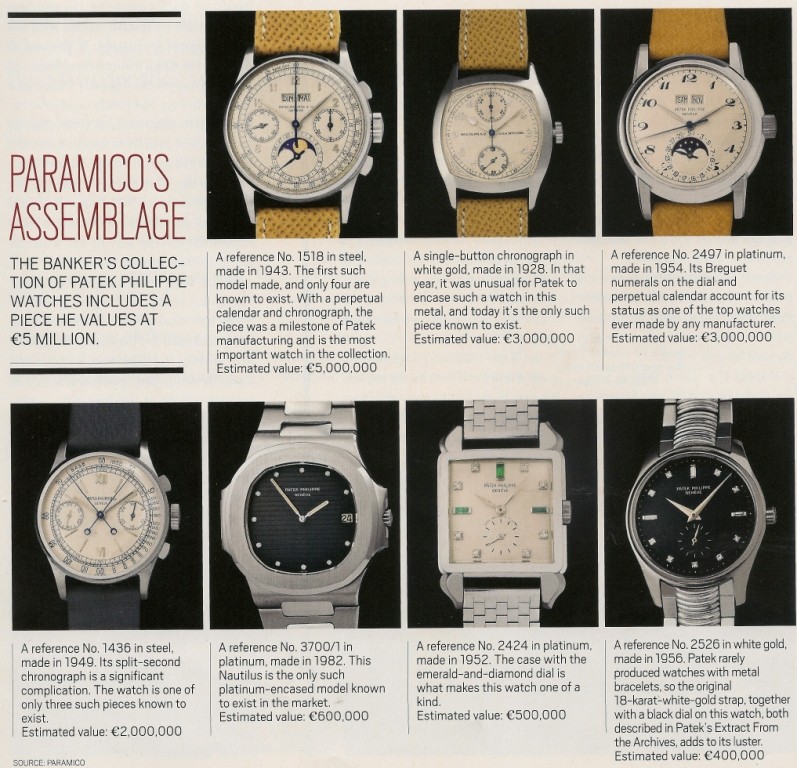
Désolé le texte de l’article est en anglais :
- Citation :
-
Time is Money
As Alfredo Paramico pulls up in a blue Audi at the 178-year-old neoclassical Four Seasons Hotel des Bergues in Geneva, the staff snaps into action. « Monsieur Paramico has arrived, » a doorman says into a microphone on his lapel, alerting colleagues inside the hotel. With his handsome chiseled face, crisp white shirt, jacket by Neapolitan bespoke tailor Biagio Mazzuoccolo and slim jeans, Paramico looks like an actor. Located in the heart of a city that’s home to Patek Philippe SA and Rolex Group, the hotel pampers Paramico because he’s one of the world’s leading watch collectors. WThese days, as everyone from Michael Schumacher to Usher to Arnold Schwarzenegger collects mechanical watches worth tens of thousands of dollars. Paramico is in a league of his own. Now 43, the Italian banker from Milan started buying Swiss timepieces more than two decades ago, before Geneva auctions overflowed with buyers. He has devoted himself to an intensive study of rare vintage watches and put together a grouping of 10 exceptional Patek Philippe timepieces. His assemblage makes Paramico one of the top 10 collectors worldwide out of a total of about 50,000 enthusiasts, says Davide Parmegiani, a dealer in Lugano, Switzerland, who has sold luxury watches for 25 years.
« He doesn’t want to have every-thing, » says Arnaud Tellier, a consultant to collectors and watchmakers who ran the Patek Philippe Museum in Geneva for 11 years. « He selects only the cream of the cream.’ Or the best of Patek Philippe, a company founded in 1851 whose hand-crafted parts and sophisticated mechanical movements set it apart from many of its Swiss rivals. Several of Paramico’s vintage pieces date back to the 1940s and ’50s, and all of his watches are encased in either white gold, platinum or steel—rather than the more common yellow gold -giving them the name white Pateks. Six of them contain so-called complications that make the watches distinctive, such as a perpetual calendar that automatically adjusts to the start of a new month. Paramico says his collection is worth about 20 million corns ($25 million), or about €8 million more than what he paid for the watches starting in 2000.
« If I see the same patina on the dial, the same aging of the hands, the indices and the bracelet, this is what I love, » says Paramico, a discreet man whose face breaks into a smile when he talks his collection. « The satisfaction that you can receive from a vintage watch you can never get from a modern one.” Paramico is now off on a new quest to show investors that watches can earn solid returns. In 2010, Luxembourg-based Elite Advisers SA, a firm that manages wine and jewels investment funds asked Paramico to start the world’s only regulated open-ended -watch fund. he already had a day job as head of global markets at the Italian branch of Spain’s Bnco-Bilbao Vizcaya Argentaria SA, where his team in Milan buys and sells equity, debt and foreign-exchange asset. But Paramico couldn’t resist the offer and almost immediately said yes. So, after arriving home each night from the bank he typically retreats to his study in his spacious 19th-century apartment in Milan’s chic Brera district to manage his watch fund.
The study highlights his singular obsession. Its shelves are packed with more than 500 auction catalogs, and about 1,000 other watch publications. His yellowing archival material contains minute production details of classic pieces. Paramico says he scours the catalogs and speaks to collectors and dealers often until 1 a.m. in search of his next prized timepiece.
« I had more free time in the past, but it’s my passion, » says Paramico, who’s married but has no children. « I could talk about watches for a week”.
Paramico says investors seeking gains from hard assets are moving into his fund partly because the vintage watch market is not correlated with the movement of securities. At the end of August, his €19.5 million fund held 512 luxury timepieces—mostly Patek and Rolex. He says the fund could eventually swell to €250 million. It notched an 18.2 percent gain from inception at the beginning of 2011 through August 2012, beating the 11.8 percent rise in the Standard & Poor’s 500 Index. To avoid conflicts, securities regulators in Luxembourg prevent any of his watches from coming into the fund.
On a May morning in Geneva, Paramico shows a group of about 10 Swiss men and women the watches he has purchased for his fund. The pieces are mostly vintage and kept in an underground vault behind a series of security doors at the free port, a tax-free storage area. As the investors examine the watches, Paramico, who also speaks French and English, tells them that rare, high-quality pieces -will continue to appreciate because of the limited supply and growing demand, particularly from Asia. Prices of a particular type of Rolex Cosmograph Daytona, which gained famed partly because the late actor Paul Newman owned one, climbed to $105,000 last year at a Christie’s aunction from about $33,000 in 2002. Paramico’s fund owns several Paul Newman models.
When Paramico first started going to auctions in Geneva run by Christie’s, Sotheby’s and Arntiquorum in the 1990s, demand for watches was scant. There were a lot of empty seats, and a few buyers could have bought most of the catalog between them. Now, coIlectors compete for seats at standing room-only auctions, with bids by phone coming in from all the world.
During a packed Christie’s auction at the Hotel des Bergues in May, Paramico eyes a rare vintage Rolex for his fund. The yellow-gold piece has a slightly rounded case back, a black-lacquer dial and star-shaped indices. The one shortcoming: It lacks a mechanical complication such as a chronometer or stopwatch function. Bids in at least eight different currencies come in by phone and are displayed digitally on a wall covered in blue fabric behind the auctioneer.
Paramico, seated near the back of the chandelier-lit room to better scope out his competition, waits patiently before making his move for the RoleX, now at 260,000 Swiss francs ($270,000). « New bidder, blue shirt, 265! » declares the auctioneer as he points to Paramico. He and his rival get into a bidding war. The Italian banker raises his offer several times by 5.000 francs before shaking his head to withdraw, refusing to top 300,000 francs, the winning bid that’s twice Christie’s high estimate. Paramico says he calibrates values based on quality, age, uniqueness and complications and is careful not to overpay. Particularly when buying for his fund. « When we reach 300,000 for a time-only Rolex, even if very rare and very particular, we need to say stop, » he says.
The son of an engineer, Paramico recalls first becoming fascinated with watches as a young child in Naples, Italy. A family photo shows him as a 6-year-old coveting his mother’s Zenith. Small yet weighty objects appealed to him, and to this day, he often carries a watch in his pocket because of the sense of security it gives him. As a teenager, be began buying inexpensive timepieces, partly with money he earned making deliveries for a pastry shop. He graduated from Bocconi University in Milan with a master’s degree in econometrics and took a job trading options on government bonds at Bankers Trust in London in 1994. Armed with a bigger salary, he began plunking, down $200,000 on high-end pieces. Seeking even higher quality, he honed in on Pateks, buying one in 1999 with a pink-gold case, calendar, chronograph and function showing moon phases he paid the equivalent of €225,000 and sold it a few years later for €450.000 after deciding to refine his collection to just white Pateks. « White is considered more chic, and there’s notning more exclusive than white Pateks… » Parmegiani, the dealer says.
Paramico has spent more than €1 million for several of the watches his personal collection. He estimates he has devoted about 90 percent of his career earnings to his watch-, with enough left over for his 2009 599 GTB Ferrari and paintings by Italian postmodernists such as Mario Schifano. »When you work in finance and start running a book you basically need to take a view, and this is where my success in watches comes from, » Paramico says. « Every important watch I bought, when thought it, many people said I overpaid. Now, the prices I paid look ridiculously cheap. I take a view, and usually my view is to go for high quality and rarity. »
His strategy helps reduce- the risks of investing in an opaque market where timepieces are often privately exchanged and values are based mostly on a collector’s taste rather than hard data. Paramico says watches from newer brands often lose up to 40 per-cent of their retail value when they sell at auction. “Not to discourage people from investing or treasure assets like watches for the financial return, but there are a lot of Pitfalls to be aware of,’ says Emily Haisley an analyst at London based Barclays Plc. « It is very difficult to get a correct picture of what these markets are doing; it’s very rare you have reliable market index.”
Paramico, who gathers pricings data from auctions and other collectors, made the biggest wateh purchase of his life in 2007. Four years earlier, he began his pursuit of the first of only four known steel Pateks, reference number 1518, that feature a perpetual calendar and chronograph. Paramico knew the owner—the world of elite watch collectors is small—and contacted him. But the owner, an Italian in the textile industry, didn’t want to sell the Patek. Paramico persisted, often meeting him for dinner during auction weekends in Geneva and in Italy. In 2007, at Hotel des Bergues, the owner told Paramico he was selling his vintage watches to focus on contemporary models.
Paramico could have the steel Patek for €2.2 million, almost five times what the owner had paid in the early 1990s. The banker said yes on the spot. « It’s one of the most sought-after watches ever, » says Paramico, sitting next to the table where he struck the deal. “When I shook his hand, I felt like I could have walked on the lake.”
.
11 novembre 2012 à 23h59 #420001903505 Duk3Membre
Intéressant, certains placent bien leur argent dans des voitures de collections…
Mais le prix des montres étant assez haut aujourd’hui je me demande si c’est le bon moment pour investir
Après des montres comme les Patek ne répondent surement pas des mêmes lois du marché que les autres… J’avoue avoir eu la flemme de lire l’article a cette heure ci et en anglais qui plus est, mais comment est calculé le rendement ou la perte, par rapport à la cote? comment celle-ci est elle définie? L’investisseur investit il sur une montre ou sur la collection entière à la manière d’une OPCVM? Et comment ça se passe si des investisseurs souhaitent récuperer leurs fonds? Aller hop on vend tout! 12 novembre 2012 à 8h17 #420001903506BRxavierMembre
- Duk3 a écrit:
- Intéressant, certains placent bien leur argent dans des voitures de collections…
Mais le prix des montres étant assez haut aujourd’hui je me demande si c’est le bon moment pour investir
Après des montres comme les Patek ne répondent surement pas des mêmes lois du marché que les autres… J’avoue avoir eu la flemme de lire l’article a cette heure ci et en anglais qui plus est, mais comment est calculé le rendement ou la perte, par rapport à la cote? comment celle-ci est elle définie? L’investisseur investit il sur une montre ou sur la collection entière à la manière d’une OPCVM? Et comment ça se passe si des investisseurs souhaitent récuperer leurs fonds? Aller hop on vend tout!
Apparemment cela fonctionne plutôt comme un « Open-ended fund » régulé au Luxembourg, mais il est vrai que le marché est sans doute un peu trop toppish pour investir et ce type d’article le montre !
Quand on commence à vous proposer d’investir dedans c’est qu’il est déjà trop tard pour le faire !12 novembre 2012 à 8h37 #420001903507 tomducatMembre
Exact quand ça rapporte plus ou plus assez on fait appel au peuple et peu de temps après tout se casse la gueule , comme de par hasard
12 novembre 2012 à 11h10 #420001903508BRxavierMembre- Duk3 a écrit:
- J’avoue avoir eu la flemme de lire l’article a cette heure ci et en anglais qui plus est, mais comment est calculé le rendement ou la perte, par rapport à la cote? comment celle-ci est elle définie? L’investisseur investit il sur une montre ou sur la collection entière à la manière d’une OPCVM? Et comment ça se passe si des investisseurs souhaitent récuperer leurs fonds? Aller hop on vend tout!
Le principe du fond n’est pas décrit en détails dans l’article, mais je comprends que ce fond est une Sicav.
A priori donc cela signifierait achat et vente des parts du fond par le fond directement à la NAV des montres détenues par le fond.
Après recherche, je pense que le nom précis du fond est « Elite Precious Time Cap », la valeur du fond est de 22.82M€ au 31/10/2012.
Ce gestionnaire gère aussi des fonds sur des bijoux, et des grands crus.12 novembre 2012 à 11h51 #420001903509 Zorba06Membre
AMHA, encore un attrape couillon. (quid de la sortie en numéraire, quid du contrôle du stock, etc.)
Dans le même style mais plus rémunérateur et moins risqué il y a des fonds basés sur les vins avec achats H.T et stockage dans le Port Franc de Genève.
Or il est plus facile d’écouler du vin que des montres et en plus le vin a une cote quasi mensuelle
12 novembre 2012 à 13h57 #420001903510BRxavierMembre- Zorba06 a écrit:
- AMHA, encore un attrape couillon. (quid de la sortie en numéraire, quid du contrôle du stock, etc.)
Dans le même style mais plus rémunérateur et moins risqué il y a des fonds basés sur les vins avec achats H.T et stockage dans le Port Franc de Genève.
Or il est plus facile d’écouler du vin que des montres et en plus le vin a une cote quasi mensuelle
Le contrôle du stock (entrée/sortie) est géré par A Paramico.
La sortie en numéraire est géré, à mon avis, par un volant de cash détenu par le fond, et par la vente de petites pièces par rapport aux PP de grandes valeurs (le fond détient de nombreuses Paul Newman par exemple dont la côte est connue de façon assez précise).
Les montres sont aussi stockées dans un coffre-fort de banque situé dans une zone franche, c’est précisé dans l’article.
.
12 novembre 2012 à 14h54 #420001903511Zorba06Membre- BRxavier a écrit:
-
- Zorba06 a écrit:
- AMHA, encore un attrape couillon. (quid de la sortie en numéraire, quid du contrôle du stock, etc.)
Dans le même style mais plus rémunérateur et moins risqué il y a des fonds basés sur les vins avec achats H.T et stockage dans le Port Franc de Genève.
Or il est plus facile d’écouler du vin que des montres et en plus le vin a une cote quasi mensuelle
Le contrôle du stock (entrée/sortie) est géré par A Paramico.
La sortie en numéraire est géré, à mon avis, par un volant de cash détenu par le fond, et par la vente de petites pièces par rapport aux PP de grandes valeurs (le fond détient de nombreuses Paul Newman par exemple dont la côte est connue de façon assez précise).
Les montres sont aussi stockées dans un coffre-fort de banque situé dans une zone franche, c’est précisé dans l’article.
.
tu dépends d’un seul type…ça ne te rappelle rien??
12 novembre 2012 à 16h00 #420001903512 francknwatchMembre
- Zorba06 a écrit:
- AMHA, encore un attrape couillon. (quid de la sortie en numéraire, quid du contrôle du stock, etc.)
Distribution des dividendes en Seiko…Ou pire.

Valorisation bidon, car si rien n’est vendu, pas de rendement et pas de pertes (vs achat) surtout.
12 novembre 2012 à 16h51 #420001903513BRxavierMembre- Zorba06 a écrit:
-
tu dépends d’un seul type…ça ne te rappelle rien??
Je simplifiais, car je comprends que Paramico conseille le fond pour ses acquisitions, mais le gestionnaire officiel du fond est un professionnel de la gestion des SICAVs.
Mais je suis bien d’accord avec toi sur le fait que ce type d’article montre bien que la hausse du prix des Patek vintages en salle des ventes est plutôt derrière nous que devant nous.
On trouve ce type de fonds quand les prix sont déjà au sommet.
13 novembre 2012 à 10h51 #420001903514Zorba06Membre- BRxavier a écrit:
-
- Zorba06 a écrit:
-
tu dépends d’un seul type…ça ne te rappelle rien??
Je simplifiais, car je comprends que Paramico conseille le fond pour ses acquisitions, mais le gestionnaire officiel du fond est un professionnel de la gestion des SICAVs.
Mais je suis bien d’accord avec toi sur le fait que ce type d’article montre bien que la hausse du prix des Patek vintages en salle des ventes est plutôt derrière nous que devant nous.
On trouve ce type de fonds quand les prix sont déjà au sommet.
CQFD, valoriser la sortie des premiers fortunés par l’entrée des pigeons classes moyennes sup: le Maddof^^
13 novembre 2012 à 11h35 #420001903515BRxavierMembreOui après sur le fond, je trouve que l’estimation de ces Pateks en acier et platine est juste stratosphérique !!
Plusieurs millions d’euros pour des montres qui sont certes très rares et assez jolies, mais cela me semble des sommes énormes !13 novembre 2012 à 11h38 #420001903516DUFMembreImpressionant!!

Je ne savais pas que certaines montres pouvaient aller à 5M€ sans diamants et autres matérieux précieux!!merci du partage!
13 novembre 2012 à 15h45 #420001903517BRxavierMembreLa question est de savoir à quel niveau de la bulle sur les prix des Patek vintages, nous nous situons.
Plutôt au milieu ou plutôt vers la fin ? Dans tous les cas pas au début !13 novembre 2012 à 19h17 #420001903518lostriderMembre- BRxavier a écrit:
-
- Duk3 a écrit:
- J’avoue avoir eu la flemme de lire l’article a cette heure ci et en anglais qui plus est, mais comment est calculé le rendement ou la perte, par rapport à la cote? comment celle-ci est elle définie? L’investisseur investit il sur une montre ou sur la collection entière à la manière d’une OPCVM? Et comment ça se passe si des investisseurs souhaitent récuperer leurs fonds? Aller hop on vend tout!
Le principe du fond n’est pas décrit en détails dans l’article, mais je comprends que ce fond est une Sicav.
A priori donc cela signifierait achat et vente des parts du fond par le fond directement à la NAV des montres détenues par le fond.
Après recherche, je pense que le nom précis du fond est « Elite Precious Time Cap », la valeur du fond est de 22.82M€ au 31/10/2012.
Ce gestionnaire gère aussi des fonds sur des bijoux, et des grands crus.
je serais bien curieux de savoir comment l’admin du fonds determine la NAV…
 y’a pas vraiment de quote officielle, et la liquidite est pas top sur ces sous-jacents… prevoir une grosse decote si on doit sortir rapidement.
-
AuteurMessages
- Vous devez être connecté pour répondre à ce sujet.